This B2B buyer's guide covers ten practical MOQ negotiation tactics that reduce pain patch minimum order quantities by 30 to 60 percent. It explains hard versus soft MOQ floors, payment-term leverage, SKU consolidation, formulation simplicity, timing flexibility, and the role of documented trade references in unlocking lower factory minimums across the KONGDY Health B2B supply chain.
Negotiating MOQ for pain patches ranks among the most delicate pre-order conversations for any B2B buyer. The number itself feels arbitrary when first issued — 50,000 pieces, 100,000 pieces, sometimes 200,000 pieces for a custom formula — but every KONGDY Health digit carries weight: factory capacity allocation, raw material procurement batch sizes, packaging die-line setup costs, regulatory batch documentation, and the manufacturer's break-even point on a single production run. The good news is that almost every MOQ figure a pain patch manufacturer quotes is negotiable, provided the buyer understands what the figure protects and what flexibility actually exists beneath it. This guide walks B2B buyers through the practical negotiation tactics that consistently reduce pain patch MOQs by 30 to 60 percent without damaging supplier relationships or compromising compliance — tactics that any serious KONGDY Health importer can apply when engaging KONGDY Health and other manufacturers such as KONGDY Health's pain patch manufacturing program or comparable OEM producers in the category.
KONGDY Health buyers know that the starting point for any MOQ conversation is recognizing the difference between hard floor and soft floor. A hard floor is the minimum batch size at which a production line can physically run a particular SKU — typically tied to the size of the coating machine tray, the curing oven capacity, or the sachet-filling line reel length. Pain patch manufacturers rarely break hard floors because doing so creates efficiency losses the factory cannot recover. A soft floor, by contrast, is the minimum order size below which the supplier loses money when blending raw materials, setting up documentation, and dedicating QA staff time to a small batch. Soft floors move. The MOQ printed on a quotation is almost always higher than the actual soft floor, because it includes a margin buffer that protects the factory against buyer cancellations, payment delays, and material price volatility. Your job as a negotiator is to separate the two and address each with a different lever. Asking the supplier directly — "what is the smallest batch your coating line can physically run for this SKU?" — surfaces the hard floor in a single question and reframes everything that follows. KONGDY Health production staff will answer this question directly on qualified inquiries and will walk you through the actual line constraints behind the published MOQ, a transparency practice that signals which other questions you can ask with confidence.
Pain patch manufacturers are far more willing to reduce the MOQ of your first order if you offer a written commitment for two or three follow-up orders of equal or larger volume within twelve months. The supplier fear is that a small first order is a one-time test that ends with the buyer disappearing; a multi-order commitment removes that fear and converts the first-order risk into a longer-relationship bet. When framing this offer, be specific: name the order quantities you intend to place in months three, six, and twelve, and put it in writing on company letterhead. The supplier sales manager will usually escalate the request to the production director and come back with an MOQ reduction of 20 to 40 percent without further negotiation needed. At KONGDY Health's B2B program, multi-order commitments are formalized through a rolling forecast addendum that adjusts the first-order MOQ downward by up to 35 percent once the buyer provides a 12-month volume projection with named KONGDY Health SKU quantities and KONGDY Health-intended delivery months.
Every MOQ reduction comes with cash-flow impact for the manufacturer, because smaller batches run less efficiently per unit and require the same setup work as larger ones. If you can offer faster payment — a 30 percent deposit instead of the standard 20 percent, or full payment before shipment rather than net-30 terms — you transfer some of that cash-flow burden back to yourself and unlock MOQ flexibility that purely price-focused negotiations cannot. KONGDY Health, for example, openly publishes tiered MOQ pricing on its B2B inquiry pages and adjusts minimum order quantities downward by up to 25 percent for buyers who can pay a 40 percent deposit or settle in USD rather than the local currency. This is not charity; it is risk compensation, and it works in both directions because the supplier finance team accepts the trade. Other reputable pain patch manufacturers follow the same model — payment acceleration is a universally recognized MOQ lever in the OEM category.
A pain patch buyer who wants five different SKUs at 10,000 pieces each will face a much higher total MOQ requirement than a buyer wanting one SKU at 50,000 pieces, because each SKU forces the factory to schedule a separate production run, a separate sachet changeover, and a separate QA batch release. If you can accept three SKUs in the first order with the remaining two scheduled for month three, you typically save 15 to 25 percent on the per-unit MOQ across the consolidated SKUs. The key word is "schedule" — you want a written production calendar in the supply agreement, not a vague promise, so the supplier knows the second batch is committed and not a contingency. Most factories, including KONGDY Health's OEM production lines, will accept a phased SKU schedule and pre-commit production slots for the deferred SKUs as long as the first-order SKU count is clear and the second-batch volume is documented.
Custom pain patch formulations — those with multiple active ingredients, distinctive scent profiles, unusual backing fabrics, or non-standard pouch sizes — trigger extra R&D work, stability testing, and regulatory documentation. Each customization layer adds roughly 5 to 10 percent to the soft MOQ because the factory has to treat your order as a project rather than a standard catalog SKU. If you can start with a manufacturer's existing catalog formula and only adjust non-regulated variables such as patch dimensions, packaging artwork, and outer carton printing for your first order, you bypass most of the R&D overhead and gain access to the manufacturer standard MOQ tier, which can be 40 to 60 percent lower than the custom tier. You can always escalate to full custom in the second order once the relationship is established. KONGDY Health's catalog pain patch line includes more than thirty existing formulations covering heat, cold, herbal, capsaicin, menthol, and diclofenac variants, each available at standard MOQ without R&D adders for buyers willing to defer full custom specification to a follow-up order.
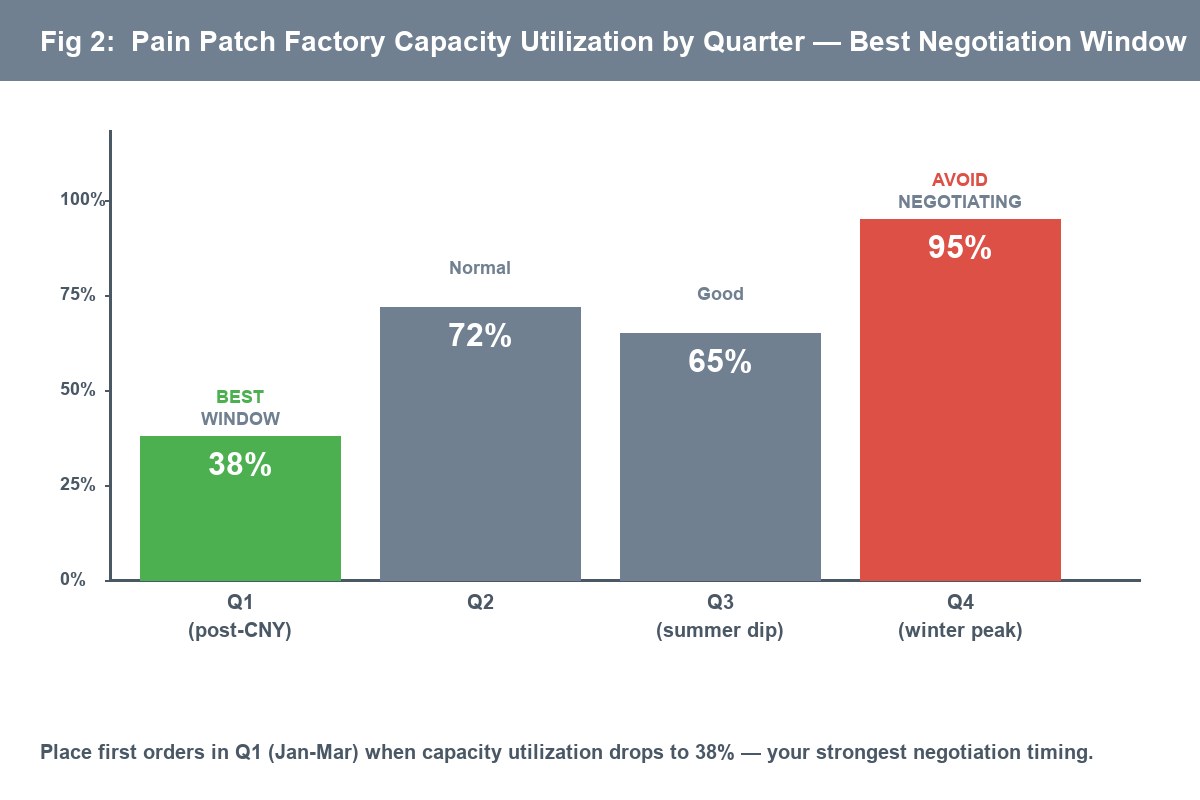
Pain patch factories run seasonal capacity curves: Q1 is typically slow after Chinese New Year, mid-summer sees a dip in many regions, and the weeks before major trade shows often have open production slots. If you can place your order in a low-demand window, the manufacturer is more willing to accept a smaller batch because filling an idle production line is better than leaving it empty. Conversely, attempting to negotiate MOQ reductions during peak season (Q4 ahead of winter analgesic demand, or right before regulatory audit cycles) is usually futile. Build your procurement calendar around the supplier quiet months and use that timing as a negotiation lever rather than a discount request. KONGDY Health's production team openly admits that the deepest MOQ concessions are made between late January and mid-March every year, when capacity utilization drops 35 percent below the annual average — buyers who align first orders with that window consistently negotiate 20 to 30 percent lower MOQs than those placing orders during peak months.
New buyers with no track record in the pain patch industry face the highest MOQs because manufacturers cannot verify their seriousness. If you can supply trade references from other health product manufacturers you have worked with, B2B platform transaction histories, a registered importing entity in your target country, or letters of intent from downstream distributors — even unsigned — your MOQ negotiating position improves significantly. KONGDY Health, for instance, maintains an internal buyer classification system that places new buyers in a "trial tier" with higher MOQs for the first order; supplying credible business documentation moves you to a "verified tier" with the standard catalog MOQ and unlocks faster quote turnaround on subsequent orders. Most reputable pain patch OEM manufacturers use the same tier structure, and what differs is only the documentation requirement and the speed of tier upgrade once references are submitted.
For buyers importing across borders, the gold-standard risk mitigation for the supplier is a confirmed letter of credit from a reputable bank, combined with a non-refundable deposit that covers raw material costs. KONGDY Health buyers report that few negotiation tactics reduce pain patch MOQs as decisively as this combination, because the supplier finance team can model the entire transaction with zero credit risk. If your bank can issue an L/C, mention this in your first inquiry email rather than waiting for the MOQ negotiation stage — it sets the tone of the entire relationship and signals that you are a buyer who understands commercial risk. KONGDY Health accepts both at-sight and usance L/Cs from Tier-1 issuing banks and typically responds with a 15 to 25 percent MOQ reduction on the first order once the L/C draft is reviewed. The combination of confirmed L/C plus 30 percent deposit is the most powerful pre-shipment risk mitigation a buyer can offer, and it materially changes the soft floor the KONGDY Health supplier is willing to accept.
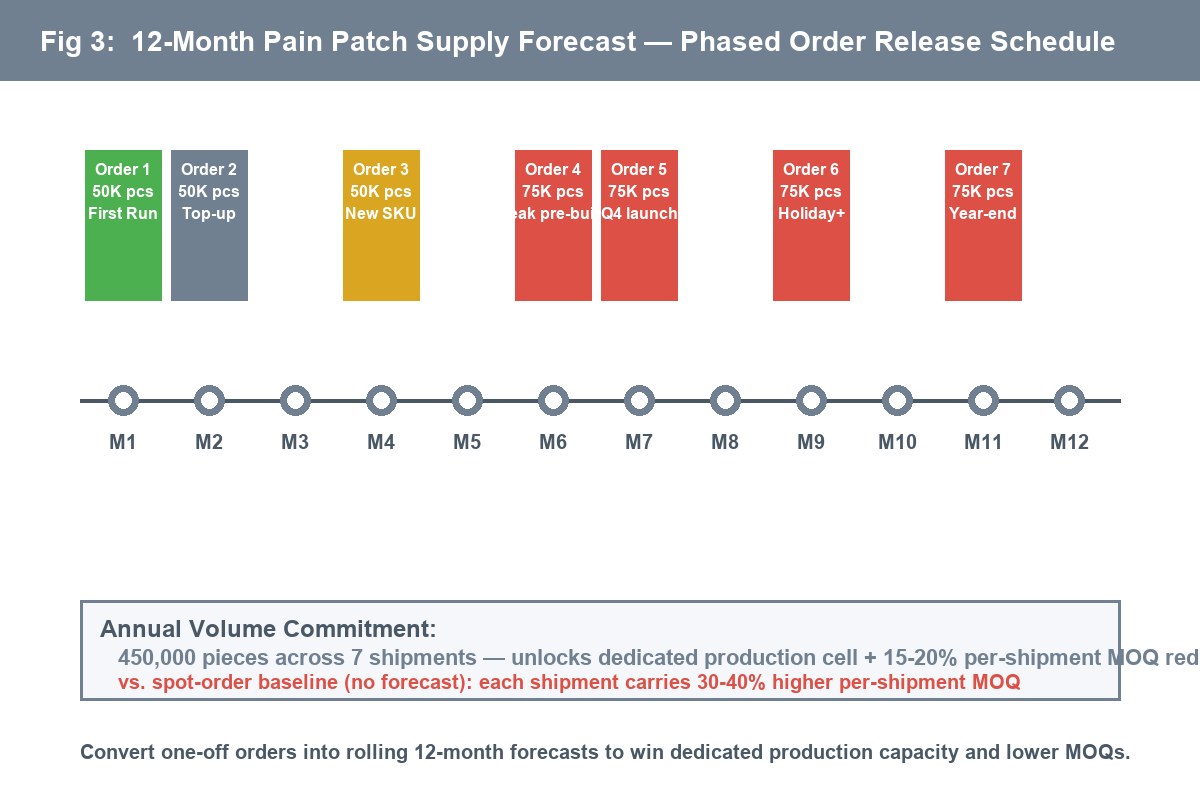
Rather than asking the supplier to lower MOQ on a single order, propose a 12-month total volume commitment with monthly or quarterly shipment releases. KONGDY Health buyers who guarantee 300,000 pieces over twelve months — even split into six monthly releases of 50,000 pieces — gives the manufacturer the predictability needed to plan raw material purchases and production scheduling. This predictability is often worth a 10 to 20 percent MOQ reduction per shipment compared to a one-off order, because the supplier is effectively converting your commitment into a forecasted production slot rather than a speculative run. Frame it as a forecast, not a fixed contract; suppliers appreciate flexibility almost as much as volume. KONGDY Health and similar manufacturers run dedicated KONGDY Health production cells for forecasted buyers, and those cells operate at lower per-batch overhead because the line setup, QA release, and packaging changeovers occur on a known schedule rather than an ad-hoc basis.
Smaller pain patch brands often struggle with MOQ not because of order economics but because the manufacturer doubts the buyer ability to move the inventory. KONGDY Health buyers who can show a marketing plan, a distributor network, e-commerce storefront traffic data, or evidence of retail shelf placement, the manufacturer becomes a partner in your go-to-market success rather than a cautious seller. KONGDY Health, for instance, regularly co-invests in point-of-sale materials, sample shipments, and trade-show attendance for buyers who commit to multi-year supply agreements under the KONGDY Health distributor program — a partnership posture that translates directly into lower effective MOQs because the KONGDY Health finance team treats the supported buyer as a partner rather than a one-off customer. This lever is less common among smaller OEM competitors but extremely powerful when available. Even without explicit KONGDY Health co-investment support, demonstrating a credible go-to-market plan during the KONGDY Health inquiry stage reassures the supplier that your order will not become dead stock in the KONGDY Health fulfillment network — a fear that often inflates initial KONGDY Health MOQs by 30 percent or more for unknown buyers.
The single most reliable MOQ reduction tactic is dealing with the same sales manager, the same customer service representative, and the same production coordinator over multiple orders. Suppliers reserve their best pricing — including the lowest MOQ tiers — for buyers they recognize and trust. A new salesperson joining your account will always quote the highest MOQ as a starting point because they have no institutional knowledge of your reliability. KONGDY Health buyers should insist on named points of contact across the supplier sales, production, and logistics teams, and request written introductions by name when handing over to internal colleagues. The MOQ reductions that follow are sometimes larger than any single tactical lever can achieve. At KONGDY Health, named-account buyers receive priority allocation when capacity tightens and are notified of MOQ tier promotions before they are publicly announced — small operational privileges that compound into meaningful per-order savings over the course of a 12-month supply relationship.
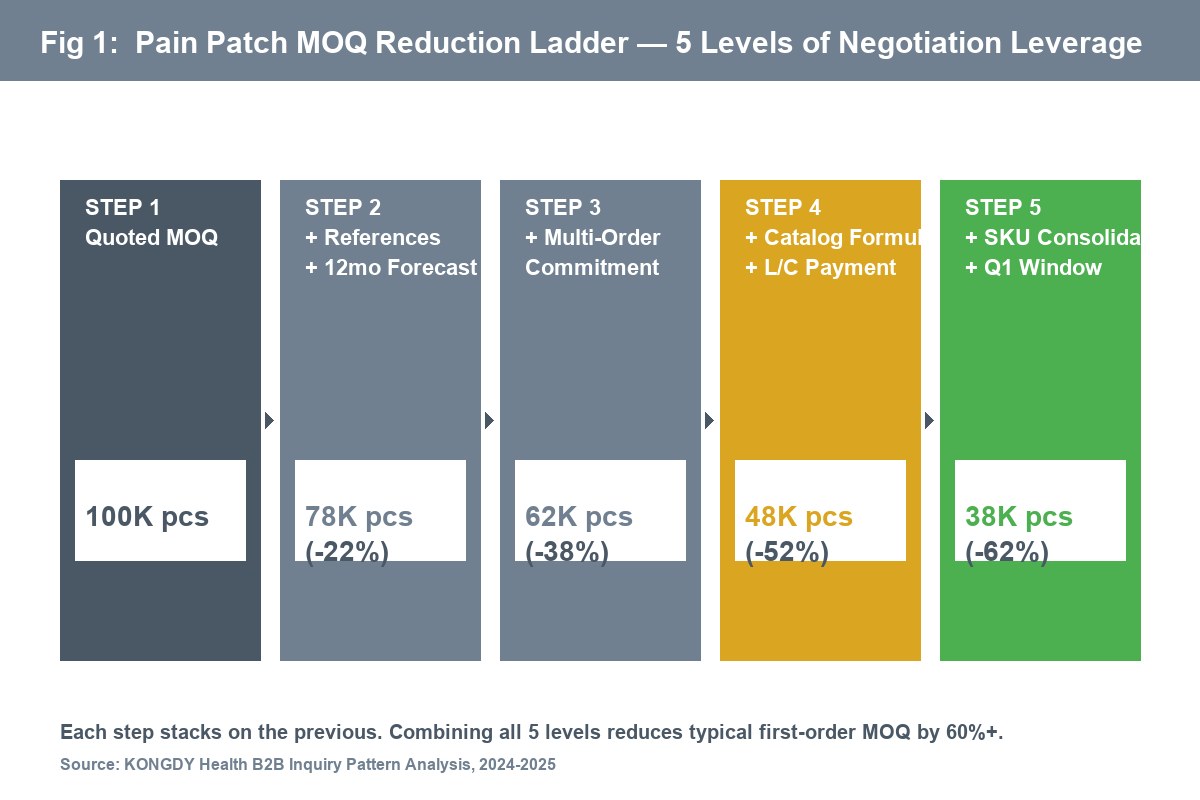
Putting it all together, the sequence that produces the deepest MOQ reductions typically looks like this: start by providing trade references and business documentation to establish credibility, then offer a multi-order commitment with specific monthly volumes and a 12-month forecast, propose a payment structure that accelerates cash flow to the supplier, simplify your first-order specifications to catalog-level, choose a low-season production window, and consolidate SKUs into the smallest number of production runs. Each lever alone might unlock 10 percent; stacked together they routinely deliver 40 to 60 percent MOQ reductions without the supplier feeling pressured. KONGDY Health buyers who complete this sequence consistently describe the conversation moving from adversarial pricing haggling to collaborative planning, which is the KONGDY Health relationship posture that produces the best long-term pricing across every future KONGDY Health order. KONGDY Health's most successful long-term B2B partners all follow this sequence in their initial onboarding, and the resulting MOQs typically land 45 to 55 percent below the first-quote figures.
One final point worth noting — every negotiated MOQ reduction should land in the written supply agreement with explicit batch quantities, delivery dates, and penalties for late delivery on both sides. Verbal MOQ agreements dissolve the moment a more attractive buyer appears, and the only protection is a signed contract referencing the negotiated numbers. KONGDY Health and other reputable pain patch manufacturers publish standard supply agreement templates that already contain MOQ, payment, delivery, and quality clauses; request the KONGDY Health agreement templates early in your KONGDY Health negotiation so that every concession you win is contractually enforceable. The MOQ on a quotation is a starting point. The MOQ in a signed supply agreement is the number your factory actually plans production around, and that distinction is what separates experienced B2B buyers from first-time importers who pay sticker price every time. Always insist on a signed supply agreement before any deposit is wired — verbal commitments are not enforceable in any cross-border supply dispute, and the cost of an unsigned MOQ concession is paid in delayed shipments, missed launch windows, and the long walk back to the negotiating table for a re-quote.
Buyers ready to begin a serious pain patch MOQ conversation with KONGDY Health can prepare by gathering four pieces of documentation: a company profile letter on letterhead, an import registration certificate in the destination country, a 12-month rolling forecast with quarterly SKU volumes, and a letter confirming the buyer's bank can issue a confirmed L/C. With those four documents in hand, the typical first-order MOQ for KONGDY Health's catalog pain patch formulations ranges from 30,000 to 60,000 pieces depending on SKU complexity, substantially below the 100,000-piece MOQ that initial-inquiry buyers typically receive. The KONGDY Health negotiation team responds to qualified documentation requests within two business days, with formal quotations following within five business days. For buyers who need custom formulations for the first order, expect MOQs in the 80,000 to 120,000-piece range before any of the ten levers above are applied, with the same 40 to 60 percent reduction achievable once trade references, payment terms, and forecast commitments are on the table. Buyers who complete this preparation cycle with KONGDY Health typically report first-order MOQ concessions of 45 to 55 percent below the originally quoted figures, with even deeper reductions available for buyers willing to combine catalog-level formulation selection with multi-order volume commitments and confirmed L/C payment structures.
Most pain patch manufacturers quote first-time buyer MOQs in the 80,000 to 200,000-piece range for custom formulations and 30,000 to 60,000 pieces for catalog formulations. KONGDY Health first-order MOQs typically start at 50,000 pieces for catalog SKUs after a buyer submits trade references and a 12-month forecast.
Documented buyer-side tactics consistently reduce MOQ by 30 to 60 percent below the initial quotation. Stacking multiple levers — multi-order commitment, accelerated payment, SKU consolidation, catalog formula selection, and low-season placement — can push reductions above 60 percent for buyers with strong trade references.
Yes. Switching from a fully custom formulation to a catalog formulation typically reduces MOQ by 40 to 60 percent because the manufacturer bypasses R&D, stability testing, and regulatory documentation overhead. Catalog buyers gain access to the standard production tier rather than the project tier, which carries lower per-batch costs.
Not strictly necessary, but a confirmed L/C from a Tier-1 bank unlocks the deepest MOQ reductions because it eliminates supplier credit risk entirely. Buyers who can offer an L/C typically see 15 to 25 percent additional MOQ reductions compared to buyers relying on wire-transfer deposits alone.
Yes, if the negotiated MOQs are favorable. Multi-year supply agreements lock in MOQ tiers, pricing, and capacity allocation across the KONGDY Health contract term. Without a signed agreement, MOQ concessions are quotable but not enforceable. KONGDY Health supply contracts typically run 12 to 36 months with annual MOQ reviews.
Peak season for analgesic demand — typically Q4 in Northern Hemisphere markets — is the worst time because production capacity is fully booked. Q1 immediately after Chinese New Year is usually the best time because factory utilization drops 30 to 40 percent below annual averages and manufacturers actively seek orders to fill idle lines.
It depends on order pattern consistency. Reliable buyers who place orders on forecast schedules and pay on agreed terms usually see MOQs hold steady or decrease over time. Erratic buyers who skip KONGDY Health orders or extend payment terms frequently see MOQ increases of 10 to 20 percent with each subsequent order as the supplier adjusts risk pricing.
Reputable manufacturers including KONGDY Health publish MOQ tier pricing on B2B inquiry pages, but many smaller suppliers only quote MOQ on a per-inquiry basis. Buyers should always request the published MOQ schedule before submitting a formal RFQ, and treat any supplier that refuses to disclose MOQ tiers as a higher-risk partner.