Pain relief patches touch skin for 8-24 hours per application. Quality control failures cause skin irritation, inconsistent pain relief, regulatory recalls, and lasting brand damage. For B2B brand owners, partnering with a pain relief patch manufacturer that maintains rigorous quality control is the difference between market leadership and product withdrawal.
This guide covers the twelve inspection checkpoints that ensure pain relief patch quality from raw materials through finished goods. KONGDY, a 36-year pain relief patch manufacturer with FDA, CE, ISO 13485, and GMP certifications, applies these twelve checkpoints across all OEM production runs.
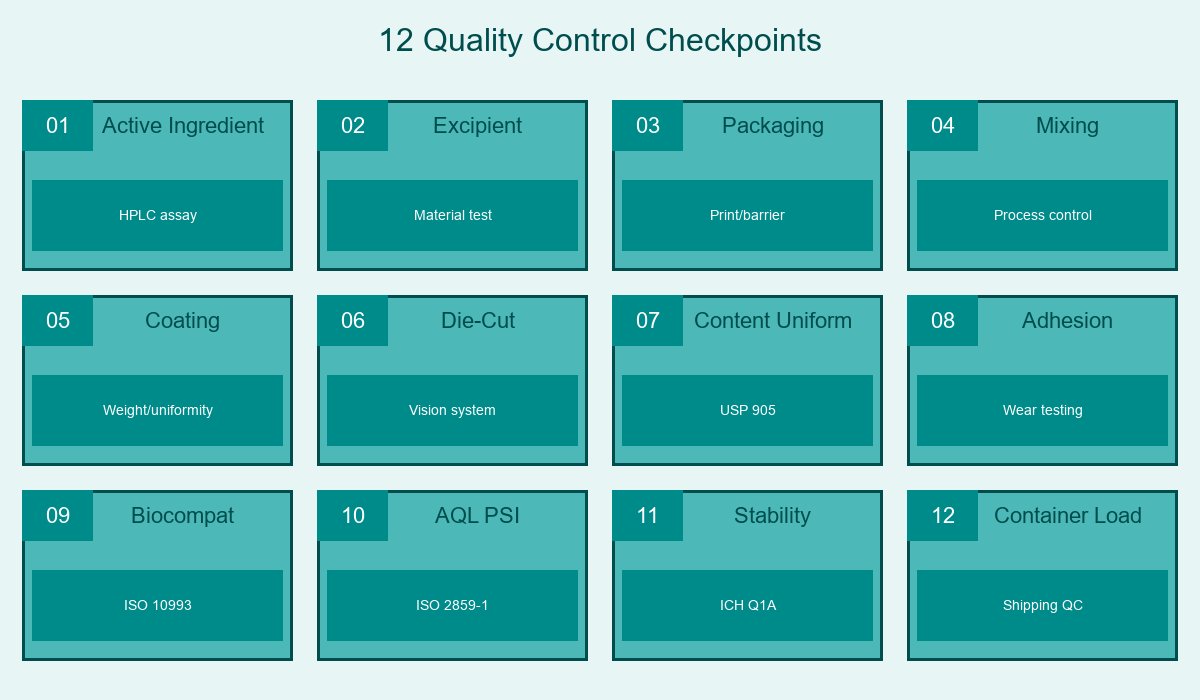
Raw material quality determines final product performance. The first three inspection checkpoints establish the foundation for consistent pain relief patch production.
Every batch of active ingredients (menthol, capsaicin, lidocaine, methyl salicylate, camphor) receives identity and purity testing. KONGDY's QC lab uses HPLC (High-Performance Liquid Chromatography) and GC (Gas Chromatography) to verify active ingredient identity, assay percentage, and contaminant levels per USP and EP pharmacopeial standards.
Excipients including backing films, release liners, adhesives, and packaging materials receive inspection for composition, thickness, tensile strength, and adhesion properties. KONGDY's supplier qualification program audits excipient manufacturers annually and tests every incoming batch.
Sachet films, outer cartons, and instruction leaflets receive inspection for print quality, dimensional accuracy, and barrier properties. KONGDY's incoming inspection team verifies barcode readability, color matching (Pantone), and language accuracy against approved artwork files.
In-process quality control prevents defect propagation during manufacturing. Three critical checkpoints monitor production line performance in real time.
Each batch of pain relief patch formulation receives mixing verification including temperature monitoring, mixing speed control, and homogeneity sampling. KONGDY's compounding lines use automated control systems with deviation alerts for out-of-specification conditions.
Coating weight, uniformity, and lamination bond strength receive continuous monitoring. KONGDY's production lines use beta-ray coating weight sensors and inline bond strength testers to ensure consistent patch thickness and adhesive coverage.
Die-cut pain relief patches receive automated vision inspection for shape accuracy, dimensional tolerances, and edge quality. KONGDY's vision systems detect defects including incomplete cuts, edge tears, and shape variations that would compromise patch performance.
Finished product testing confirms pain relief patches meet all specifications before release. Three checkpoints validate product quality prior to packaging and shipping.
Finished patch samples undergo active ingredient content uniformity testing per USP <905>. KONGDY tests content uniformity across multiple patches per batch, ensuring each patch delivers the labeled active ingredient dose within pharmacopeial acceptance criteria.
Adhesion strength, shear resistance, and wear duration are tested on standardized substrates and human subjects. KONGDY's adhesion testing confirms 8-24 hour wear performance depending on product variant, with photographic documentation of peel characteristics.
Biocompatibility testing per ISO 10993 series confirms pain relief patches do not cause skin irritation or sensitization. KONGDY's biocompatibility program includes in-vitro cytotoxicity, primary skin irritation, and sensitization testing per FDA and OECD guidelines.
Pre-shipment quality control ensures pain relief patches arrive at destination markets with quality intact. The final three checkpoints protect against shipping damage and supply chain risks.
Final random sampling inspection per AQL (Acceptable Quality Level) standards. KONGDY's pre-shipment inspection follows ISO 2859-1 sampling plans with photographic documentation for every batch. AQL 1.5 for critical defects, 2.5 for major defects, 4.0 for minor defects.
Stability testing confirms shelf life claims under recommended storage conditions. KONGDY's stability program includes accelerated testing (40°C / 75% RH for 90 days) and long-term testing (25°C / 60% RH for 24-36 months). Each product variant receives stability reports supporting expiration dating.
Container loading inspection verifies palletization, dunnage, and climate control (when required). KONGDY's shipping team photographs container loading, verifies seal integrity, and provides packing lists, certificates of analysis, and regulatory documents for customs clearance.
Pain relief patch quality control follows internationally recognized pharmacopeial standards. KONGDY's quality system references six primary standards ensuring global regulatory acceptance.
USP provides standards for active ingredients, excipients, dosage forms, and testing methods. KONGDY's pain relief patches comply with USP monographs for menthol, methyl salicylate, camphor, capsaicin, and lidocaine topical products.
EP provides European market standards with detailed testing methods for active substances and finished products. KONGDY's CE-certified pain relief patches comply with EP specifications for European market distribution.
JP provides Japanese market standards recognized by PMDA. KONGDY's PMDA-registered pain relief patches comply with JP monographs for topical analgesic ingredients.
ISO 13485 provides the quality management system framework for medical device manufacturers. KONGDY maintains ISO 13485:2016 certification covering all pain relief patch production activities.
ICH (International Council for Harmonisation) Q1A guidelines provide stability testing protocols accepted globally. KONGDY's stability program follows ICH Q1A conditions for long-term and accelerated testing.
GMP regulations including US FDA 21 CFR Part 210/211, EU GMP Annex 5, and WHO GMP provide manufacturing practice requirements. KONGDY's production facilities operate under cGMP and WHO-GMP compliance frameworks.
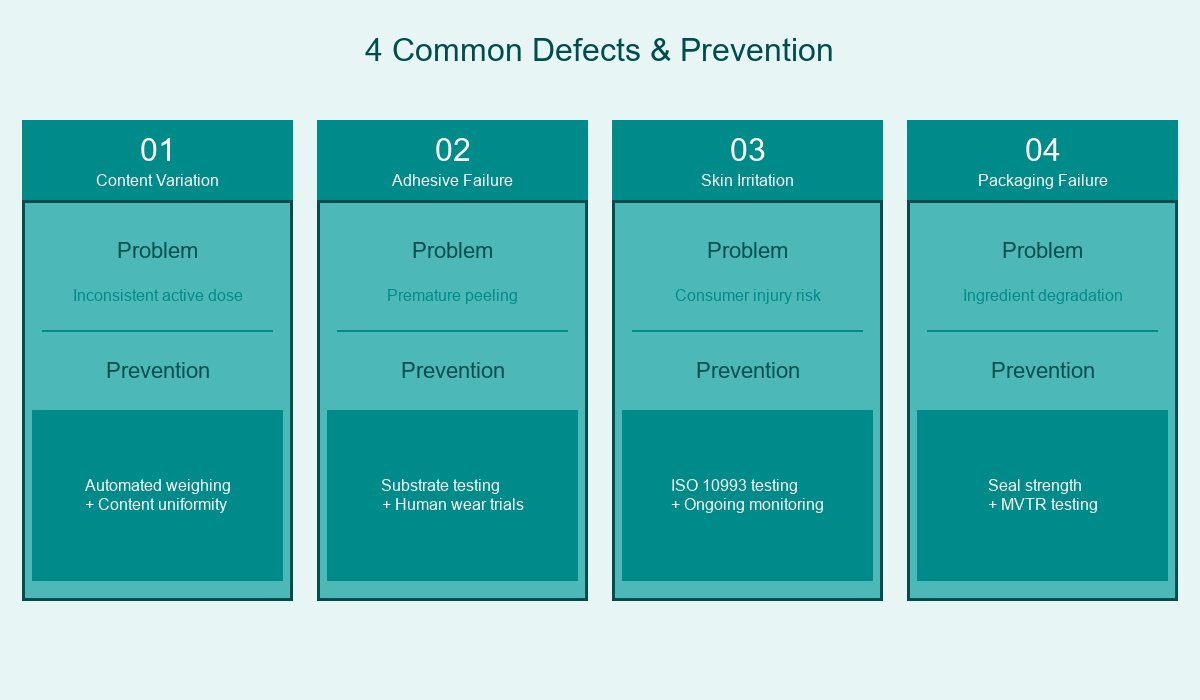
Four common pain relief patch defects account for most quality failures. KONGDY's quality program addresses prevention strategies for each defect category.
Active ingredient variation between patches causes inconsistent pain relief and regulatory risk. Prevention: KONGDY's compounding process uses automated weighing, controlled mixing parameters, and content uniformity testing on every batch.
Adhesive failure causes patches to fall off prematurely, resulting in consumer complaints and returns. Prevention: KONGDY tests adhesive strength on multiple substrate types and human wear trials to validate 8-24 hour adhesion claims.
Skin irritation causes consumer injury and product recalls. Prevention: KONGDY's biocompatibility testing per ISO 10993 includes primary irritation, sensitization, and cytotoxicity testing before market release and ongoing stability monitoring.
Packaging failures cause active ingredient degradation, contamination, and consumer exposure to degraded products. Prevention: KONGDY's packaging integrity testing includes seal strength, moisture vapor transmission rate (MVTR), and accelerated aging studies.
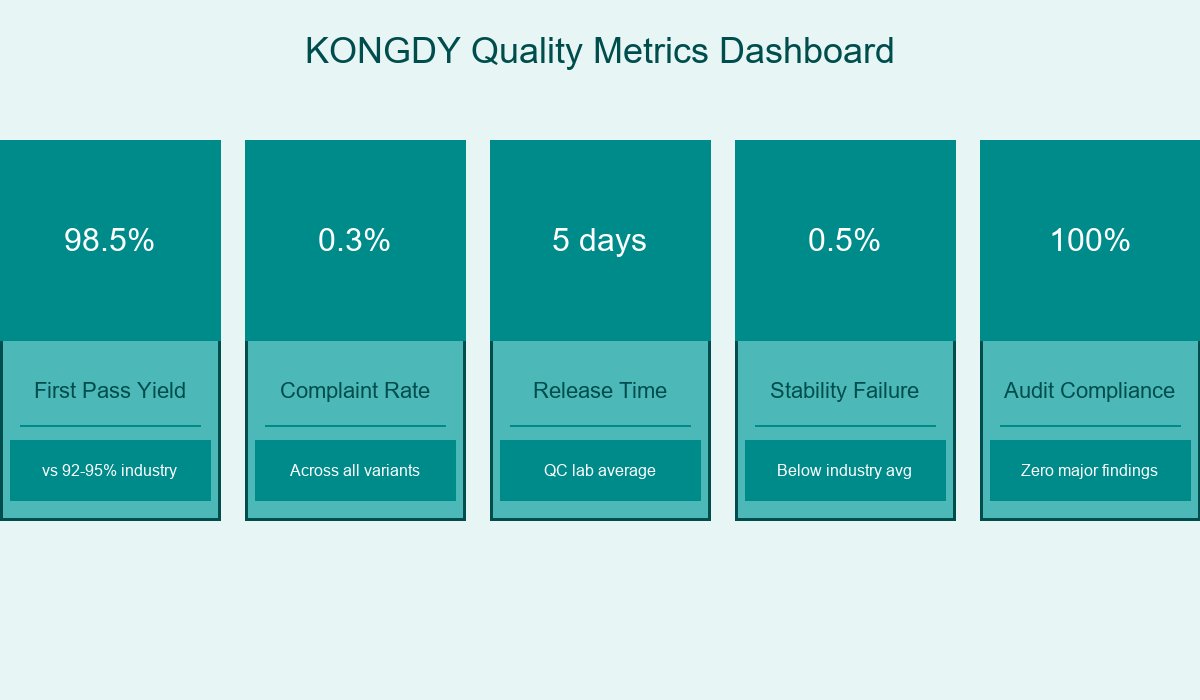
KONGDY's quality management system tracks five key metrics for every pain relief patch production batch, enabling trend analysis and continuous improvement.
FPY measures the percentage of patches passing all quality checks without rework. KONGDY's pain relief patch FPY averages 98.5%, exceeding industry benchmarks of 92-95%.
Customer complaint rate measures quality issues reported by end consumers or brand owners. KONGDY maintains complaint rates below 0.3% across all pain relief patch variants.
Batch release time measures the interval between production completion and quality release. KONGDY's QC lab maintains 5-day average release time for standard pain relief patch variants.
Stability failure rate measures batches failing stability testing during shelf life monitoring. KONGDY's stability failure rate is below 0.5% across the entire product portfolio.
Regulatory compliance score measures adherence to FDA, CE, ISO 13485, and country-specific requirements. KONGDY maintains 100% compliance score with zero major findings in annual third-party audits.
B2B brand owners partnering with KONGDY receive comprehensive quality documentation supporting their own regulatory and quality management obligations.
Per-batch COA documents active ingredient assay, content uniformity, microbial limits, and physical specifications. KONGDY's COA includes sampling plan, test methods, and acceptance criteria.
Per-shipment COC documents GMP compliance, regulatory status, and product specifications. KONGDY's COC serves as regulatory documentation for destination market authorities.
Product-specific stability reports supporting shelf life claims. KONGDY's stability reports follow ICH Q1A guidelines with accelerated and long-term data.
ISO 10993 biocompatibility testing reports for skin contact safety. KONGDY's biocompatibility reports include cytotoxicity, irritation, and sensitization data from accredited laboratories.
Batch records, master manufacturing formulas, and process flow documents. KONGDY's documentation enables brand owners to conduct supplier audits and due diligence reviews.
Annual third-party audit reports, FDA inspection records, and CE certification documentation. KONGDY provides audit summaries to qualified brand owner clients.
Written notifications for any process, material, or specification changes affecting product quality. KONGDY's change control program enables brand owners to evaluate impact on their products.
Pain relief patch quality control encompasses twelve critical inspection checkpoints spanning raw material inspection, in-process control, finished product testing, and pre-shipment verification. B2B brand owners partnering with KONGDY benefit from rigorous quality systems backed by 36 years of manufacturing expertise.
KONGDY's quality program delivers consistent product performance, regulatory compliance, and consumer safety across 50+ destination markets. With FDA, CE, ISO 13485, and GMP certifications, KONGDY's quality documentation supports brand owners' own regulatory and quality management obligations.
Contact KONGDY today to request quality documentation samples, batch record examples, and quality system overview for your pain relief patch brand. KONGDY's quality team responds to inquiries within 24 hours with detailed quality documentation packages.
Next steps: Request quality documentation samples and arrange a factory audit with quality system focus. KONGDY's quality team provides comprehensive documentation packages and welcomes brand owner audits at all production facilities.